Artificial intelligence is becoming part of the digital orthodontic workflow, but "AI-powered treatment planning" can mean very different things.
For a broader view of platform scope and case fit, explore the digital dental design software DPL works with.
In one system, AI may automatically identify and segment teeth from a scan. In another, it may help register intraoral scans with CBCT data, calculate measurements, generate part of a digital setup, predict a treatment-related outcome, or monitor changes between appointments.
Those are valuable capabilities, but they are not the same as independently planning an entire clear-aligner case.
That distinction matters.
Clear aligner treatment planning combines digital tools with decisions about treatment objectives, tooth movement, sequencing, anchorage, attachments, interproximal reduction (IPR), occlusion, biological limits and clinical approval.
AI can increasingly assist with parts of that process. Current evidence, however, does not support treating AI as a replacement for professional orthodontic judgment or experienced human review.
This guide looks at where AI is already useful in clear aligner treatment planning, where the evidence is promising, where important limitations remain, and what the technology may mean for digital orthodontic workflows in the years ahead.
What Does "AI" Mean in Clear Aligner Treatment Planning?
Artificial intelligence is often used as a broad marketing term, but not every automated feature in orthodontic software is necessarily an AI system.
Traditional software can follow predefined rules.
Automation can perform repetitive steps without human input.
Machine-learning and deep-learning systems learn patterns from data and may be used for tasks such as image recognition, segmentation, classification, prediction or decision support.
In a clear aligner workflow, these technologies may appear at different stages:
- identifying individual teeth in a digital model
- segmenting anatomical structures
- registering intraoral scan and CBCT datasets
- performing measurements
- assisting with virtual setup generation
- supporting treatment-related predictions
- comparing progress records
- assisting remote monitoring
The important question is therefore not simply:
"Does the software use AI?"
A more useful question is:
"Which part of the workflow uses AI, how was that function validated, and where is human review still required?"
For the fundamentals beyond AI, see our clear aligner treatment planning guide.
Where Is AI Being Used in Clear Aligner Workflows Today?
A 2025 scoping review by Ruiz and colleagues provides one of the clearest overviews of AI specifically in clear aligner therapy.
The authors identified 708 records and ultimately included 41 studies. Their literature and commercial-software assessment covered material available through March 2024; the results are a historical snapshot, not a complete audit of software available in 2026. [1]
Among those studies:
- 16 focused on tooth segmentation
- 4 focused on registration of digital models
- 13 investigated digital setup
- 8 investigated remote monitoring
The review also evaluated commercially available orthodontic planning software to understand how much of the digital aligner workflow had been automated.
This research shows an important pattern:
AI is not one single "treatment planning system."
It is being developed as a collection of technologies that support different parts of the workflow.
AI Applications at a Glance
1. Tooth Segmentation: One of AI's Stronger Applications
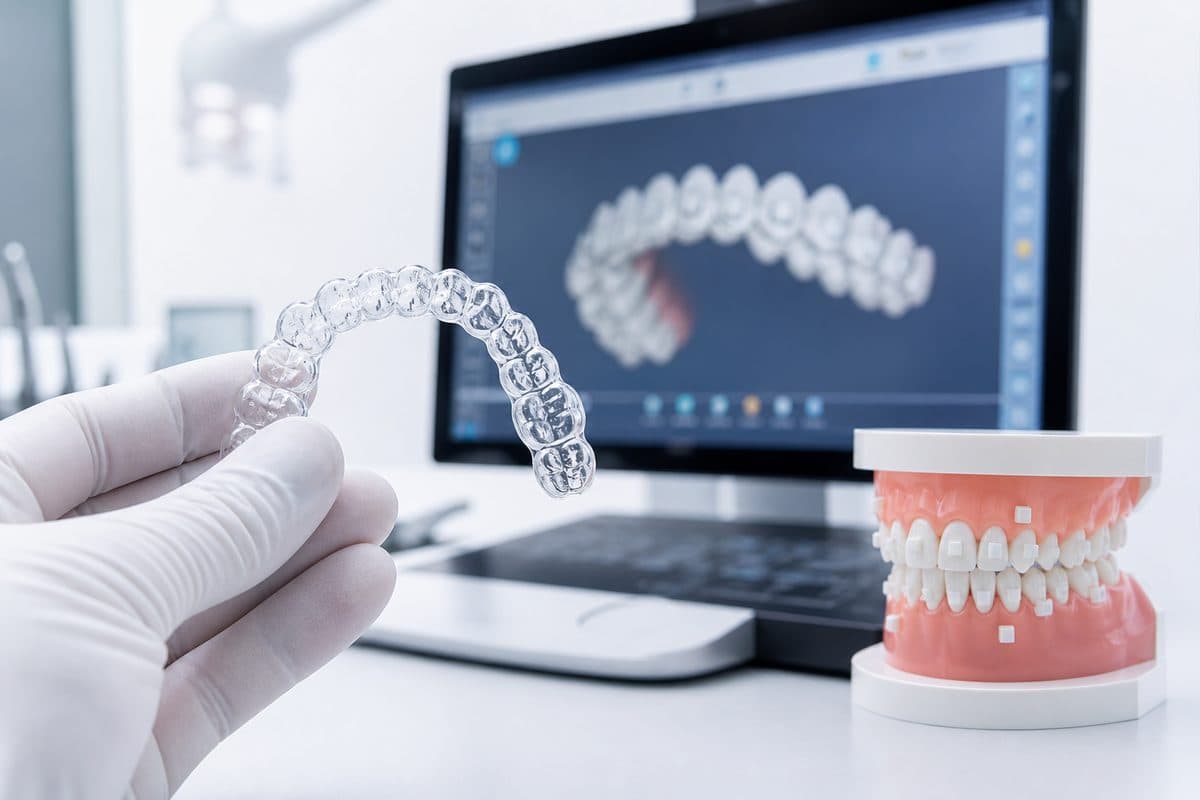
Before individual teeth can be moved in a digital orthodontic setup, the software needs to identify and separate them accurately from the digital model.
This is called tooth segmentation.
It is a repetitive and technically demanding step, making it well suited to computer-vision and deep-learning approaches.
The 2025 clear-aligner AI scoping review reported approximately 98% accuracy for AI-based tooth segmentation in the evidence it summarized. This task-specific result is not a universal benchmark across products, datasets or validation methods. [1]
That is an encouraging result.
However, it must be interpreted correctly.
A system that segments teeth accurately has demonstrated performance on the segmentation task.
It has not demonstrated that it can independently determine the correct:
- treatment objectives
- final tooth positions
- movement sequence
- attachment strategy
- IPR strategy
- anchorage requirements
- occlusal goals
- biological limits
This is one of the most important distinctions when discussing AI in digital orthodontics:
High accuracy for a narrow task does not equal high accuracy for an entire treatment plan.
2. Combining Intraoral Scans and CBCT Data
Another important application of advanced digital tools is combining different types of patient information.
An intraoral scan provides detailed information about visible crown morphology and the dental arches.
CBCT can provide three-dimensional information about structures that are not visible from the crown surface alone, including roots and surrounding anatomy.
AI-assisted registration can help align these datasets into a common digital environment.
The clear-aligner AI literature reviewed by Ruiz and colleagues found that AI has been used to support CBCT and intraoral-scan data integration. [1]
This is particularly interesting because aligner planning based only on crowns does not directly show where roots sit relative to surrounding bone.
Research reviewed by Tüfekçi and colleagues also discusses how predicted root and bone visualization may provide clinicians with additional information when evaluating clear-aligner treatment plans. [4]
The clinical value is not that AI makes the decision automatically.
The value is that better visualization may give the clinician or planning team more information on which to base a decision.
3. AI-Assisted Digital Setups
A virtual setup shows proposed tooth positions across the planned treatment sequence.
AI and automation can help generate or accelerate parts of this process.
The 2025 scoping review identified 13 studies related to digital setup, showing that this is an active area of research. [1]
But a digital setup should not be judged only by how quickly it is generated or how attractive the final model appears.
A usable aligner treatment plan still requires review of questions such as:
- Are the treatment objectives appropriate for the case?
- Are the proposed movements reasonable?
- Does enough space exist for those movements?
- Is the sequence logical?
- Are anchorage and reactive movements considered?
- Are attachments appropriate for the intended movements?
- Is IPR required, and if so, when?
- Has the final occlusion been reviewed?
- Are there anatomical or biological limitations that affect the plan?
AI may help create the digital environment in which these decisions are made.
That does not automatically make the resulting setup clinically complete.
4. AI, Staging, Attachments and IPR
Staging determines when movements occur across the aligner sequence.
Attachments help the aligner deliver and control certain force systems.
IPR can create space where appropriate and must be coordinated with the movement sequence.
These decisions are connected.
Some orthodontic software can automate or suggest elements of tooth movement, attachment placement, IPR or staging.
The key limitation is that commercial automation and scientific validation are not the same thing.
In the 2025 clear-aligner scoping review, researchers identified 13 commercial aligner software programs available through March 2024 and evaluated how automated their workflows were.
Only one demonstrated complete automation across the workflow steps assessed by the authors.
Even more importantly, none of those 13 identified commercial programs had been evaluated in the 41 scientific studies included in the review. [1]
For clinicians and dental organizations, this is a useful reminder:
A feature being available in software does not automatically mean that its clinical performance has been independently validated.
Staging, attachments and IPR should therefore remain part of a reviewed treatment-planning process rather than being accepted simply because the software generated them.
5. Prediction and Treatment-Planning Decision Support
Prediction is one of the most attractive uses of AI in healthcare.
In orthodontics, researchers have investigated whether AI systems can help with defined diagnostic and treatment-planning decisions.
A 2026 systematic review by Baxmann, Zsoldos and Kárpáti included 19 studies evaluating AI or knowledge-based systems for orthodontic diagnosis and treatment planning. [2]
Reported performance frequently exceeded 80% in the individual tasks studied and in some studies exceeded 90%. [2]
Those numbers sound impressive, but they require context.
The studies investigated different decisions, datasets, methods and outcome measures.
The review also found important methodological limitations, including predominantly moderate-to-serious risk of bias, retrospective study designs, single-center datasets and limited external validation. [2]
The authors therefore concluded that current AI systems should be regarded as adjunctive decision-support tools rather than autonomous treatment planners. [2]
This is a much more useful way to understand AI in orthodontics:
AI may help inform a decision.
It does not remove the need to evaluate whether that decision makes sense for the individual patient.
6. AI and Remote Aligner Monitoring
AI is also being studied outside the initial treatment-planning stage.
Remote-monitoring systems may compare photographs, scans or other digital records over time to identify changes or possible deviations from the expected treatment progression.
The 2025 clear-aligner scoping review identified eight studies related to remote monitoring. [1]
Potential uses include helping teams:
- compare treatment progress between visits
- identify possible tracking concerns
- prioritize patients who may require clinical review
- organize large volumes of monitoring data
Again, the safest model is decision support rather than autonomous clinical management.
A monitoring system may flag something unusual.
The clinical team still needs to determine what that finding means and whether any intervention is appropriate.
Can AI Make Clear Aligner Treatment More Predictable?
Possibly — but the word "predictable" needs to be used carefully.
AI may improve specific parts of the digital workflow by making repetitive tasks faster, helping quantify anatomy, identifying patterns in data or providing additional information for treatment planning.
That can improve the information available to planners and clinicians.
But treatment predictability does not depend on software alone.
The achieved clinical result can also be influenced by factors including:
- the biological response of the patient
- complexity of the required movements
- aligner fit and tracking
- patient compliance
- treatment-plan quality
- attachment effectiveness
- space availability
- the timing of movements
- clinical execution
A virtual prediction remains a model of intended treatment.
It should not automatically be interpreted as a guarantee of achieved tooth movement.
Can AI Reduce Clear Aligner Refinements?
It is reasonable to expect that better data analysis and better digital planning tools may help identify some planning problems earlier.
The reviews discussed here do not establish that AI will eliminate or universally reduce refinements.
Refinements may be required for many reasons, including biological variability, tracking, case complexity, patient compliance and differences between planned and achieved movement.
AI may eventually become increasingly useful for detecting those differences and supporting refinement planning.
For now, a more practical strategy is to combine digital tools with careful review of:
- treatment objectives
- movement sequence
- attachments
- IPR
- occlusion
- progress records
For a deeper discussion of those planning relationships, see our guide to attachments, IPR and staging.
Commercial AI vs Scientific Validation
One of the most important findings in the current literature is the gap between what software can automate and what has been independently studied.
The clear-aligner scoping review identified 13 commercial orthodontic software programs available through March 2024 and examined their level of automation.
Yet none of those 13 systems had been evaluated in the 41 scientific studies included in that review. [1]
That does not mean the commercial systems do not work.
It means software availability should not be confused with independent clinical validation.
When evaluating an AI-assisted planning workflow, useful questions include:
- What exactly is automated?
- What training data was used?
- Has the function been independently validated?
- Was it validated on patients similar to the population being treated?
- What happens when the software is uncertain?
- Can the planner modify the result?
- Does a qualified clinician remain responsible for final approval?
These questions are likely to become increasingly important as AI becomes more deeply integrated into orthodontic software.
AI vs Experienced Human Treatment Planning
The strongest future workflow is unlikely to be simply:
Human OR AI.
A more realistic model is:
Human + AI.
AI is particularly suited to:
- repetitive image-analysis tasks
- segmentation
- data registration
- quantitative measurements
- pattern recognition
- comparing large datasets
- screening or flagging digital records
Experienced planners and clinicians remain important for:
- interpreting treatment objectives
- evaluating competing treatment options
- understanding biomechanics
- reviewing staging logic
- evaluating anchorage
- reviewing attachments and IPR
- considering restorative and periodontal constraints
- interpreting unusual or complex cases
- determining whether a software-generated proposal is clinically appropriate
The 2024 critical review of AI in orthodontics makes this distinction clear: while a number of manufacturing and data-processing processes can be automated, orthodontic treatment planning and evaluation remain professional responsibilities. [3]
Can AI Replace an Orthodontist or Aligner Treatment Planner?
Current evidence does not support autonomous replacement of the treating clinician or the complete reviewed planning workflow.
That does not mean AI is unimportant.
AI is likely to become increasingly valuable precisely because it can reduce time spent on repetitive technical tasks and provide more information to the people making clinical and planning decisions.
The 2026 systematic review of AI in orthodontic treatment planning concluded that current systems should be treated as adjunctive decision-support tools, not autonomous planners. [2]
The 2024 critical review similarly highlighted limited generalizability and the relatively small number of orthodontic AI applications that have reached full clinical maturity. [3]
The appropriate question is therefore not:
"When will AI replace the orthodontist?"
A more useful question is:
"How can AI help orthodontists, planners and digital teams make better informed decisions while keeping appropriate human oversight?"
What This Means for Clinics and Aligner Companies
For a dental clinic or clear-aligner organization, the arrival of AI does not remove the need for a well-designed treatment-planning workflow.
It changes where time and expertise may be spent.
Automation may increasingly handle technical and repetitive steps.
Human teams can then concentrate more attention on:
- clinical objectives
- movement strategy
- difficult movements
- treatment sequencing
- quality review
- exceptions and complex cases
- communication and approval
When evaluating an internal or outsourced planning workflow, software should therefore be only one part of the decision.
Also evaluate:
- who reviews the plan
- how revisions are handled
- whether objectives are translated accurately
- whether staging is reviewed rather than blindly generated
- whether attachments and IPR are evaluated in context
- how quality assurance is performed
- how the treating clinician remains involved in approval
The DPL Approach: Technology With Human Review
At Dental Planning Lab, we view software as a planning tool rather than a replacement for planning expertise.
Digital technology can accelerate portions of the workflow, organize information and make complex setups easier to visualize.
Experienced review is still needed to evaluate whether the proposed setup aligns with the clinician-provided treatment objectives and the wider planning strategy.
Our aligner treatment-planning workflow therefore focuses on the combination of:
- digital planning tools
- structured staging
- attachment and IPR considerations
- internal quality review
- clinician feedback
- revisions before approval
- production-ready digital delivery
The treating clinician retains responsibility for diagnosis, clinical decisions and final treatment approval.
Explore our aligner treatment planning service and reviewed workflow.
What Comes Next for AI in Digital Orthodontics?
The direction of travel is clear.
Digital orthodontics is increasingly bringing together:
- artificial intelligence
- intraoral scanning
- CBCT
- three-dimensional treatment simulation
- remote monitoring
- automated manufacturing
- data-driven decision support
A 2026 editorial by Nanda and Abu Arqub describes this convergence as part of the field's evolution. It provides perspective rather than comparative evidence of treatment effectiveness. [5]
Several developments are particularly worth watching.
More Multimodal Planning
Future systems may combine more information from:
- intraoral scans
- radiographs
- CBCT
- photographs
- treatment history
- progress scans
rather than analyzing each dataset separately.
Root- and Bone-Aware Digital Setups
Better integration of crowns, roots and surrounding anatomy may help clinicians evaluate proposed movements with more anatomical context.
Better Outcome Prediction
Larger, better standardized and externally validated datasets may improve the ability of models to estimate how planned movements compare with likely clinical outcomes.
Explainable AI
For high-stakes healthcare decisions, knowing why a model produced a result may be nearly as important as the result itself.
Systems that communicate confidence, uncertainty and reasoning will be more useful than opaque recommendations that cannot be reviewed.
Human-in-the-Loop Planning
The most realistic near-term model is likely to remain one in which AI performs selected tasks while planners and clinicians review, modify and approve the treatment strategy.
That approach uses automation where it is strongest without assuming that a complex biological treatment can be reduced to a single algorithm.
Key Takeaways
- AI is already being applied to several parts of clear-aligner and orthodontic workflows.
- Tooth segmentation is one of the better-performing AI applications reported in clear-aligner research.
- AI can assist with digital-model registration, measurements, digital setups, outcome prediction and remote monitoring.
- Strong performance on an individual AI task does not prove that an entire treatment plan is accurate.
- Commercial software automation should not be confused with independent scientific validation.
- Current orthodontic evidence supports AI as a decision-support tool, not an autonomous treatment planner.
- Staging, attachments, IPR, occlusion and treatment objectives still require careful review.
- The most realistic future is likely to combine AI automation with experienced planning and clinician oversight.
Frequently Asked Questions
How is AI used in clear aligner treatment planning?
AI can assist with tasks such as tooth segmentation, digital-model registration, measurements, digital setup processes, treatment-related prediction and remote monitoring. Different systems automate different parts of the workflow, so the presence of AI does not mean the complete treatment plan is generated or validated autonomously.
How accurate is AI in clear aligner planning?
There is no scientifically defensible single accuracy percentage for "AI clear aligner planning." Performance depends on the specific task, dataset and validation method. A 2025 scoping review reported about 98% accuracy for AI tooth segmentation, but that number should not be interpreted as 98% accuracy for complete treatment planning. [1]
Can AI automatically plan attachments and IPR?
Some commercial orthodontic systems automate or suggest parts of attachment, IPR and staging workflows. However, available automation does not automatically establish independent clinical validation. These elements should still be reviewed in the context of treatment objectives, movement strategy and clinical limitations.
Can AI reduce aligner refinements?
AI may help identify patterns or planning issues earlier, but the reviews discussed here do not establish that AI will eliminate or universally reduce refinements. Refinements can also depend on biology, compliance, tracking, movement complexity and clinical execution.
Can AI replace an orthodontist?
Current evidence does not support autonomous replacement of the orthodontist or treating clinician. The 2026 systematic review describes AI as a decision-support tool. Diagnosis, treatment decisions, interpretation and final clinical approval remain professional responsibilities.
Why combine CBCT with intraoral scans for aligner planning?
An intraoral scan captures detailed crown and arch surfaces, while CBCT can provide information about roots and surrounding anatomical structures. Registering these datasets can give clinicians additional three-dimensional context when reviewing proposed tooth movements.
Will AI replace aligner treatment planners?
AI is likely to automate more repetitive technical work, but experienced review remains important for objectives, staging, biomechanics, attachments, IPR, occlusion, complex cases and quality assurance. A human-in-the-loop workflow is currently the more evidence-aligned approach.
Conclusion
Artificial intelligence is becoming an important part of digital orthodontics, but its greatest current value is not replacing the people responsible for treatment planning.
It is helping automate selected tasks, analyze digital records and provide additional information that planners and clinicians can use during review.
The evidence is strongest when AI is evaluated for clearly defined technical tasks.
The evidence becomes more limited when broad claims are made about fully autonomous treatment planning.
For clinics and aligner organizations, the practical goal should therefore not be automation at any cost.
It should be a workflow in which technology handles the tasks it performs well while experienced people remain responsible for the decisions that require clinical context, biomechanical understanding and professional judgment.
At Dental Planning Lab, that means combining digital tools with structured planning, quality review and clinician approval throughout the aligner workflow.
Want to evaluate the workflow with your own case?
Your first trial case is complimentary.
For practical next steps, read our guide to submitting an aligner case or contact our team.